
Does your provider break your tool calls?
Make your endpoint the one agents can trust.
You serve the same weights as everyone else. What sets your endpoint apart is whether its tool calls parse.
.lambda defines each model's own call format once, and uses it both to constrain generation and to parse the result. Every tool call your endpoint returns is valid.

Reliability is visible, even when requests return 200.
Every tool call looks fine to your endpoint: the request returned 200. The customer sees the failure: the model answered in text where a call was due, wrote malformed JSON, named a tool it wasn't offered, or passed arguments the schema rejects.
Tool calling is hard to get right. Providers serving the same weights end up with very different error rates.
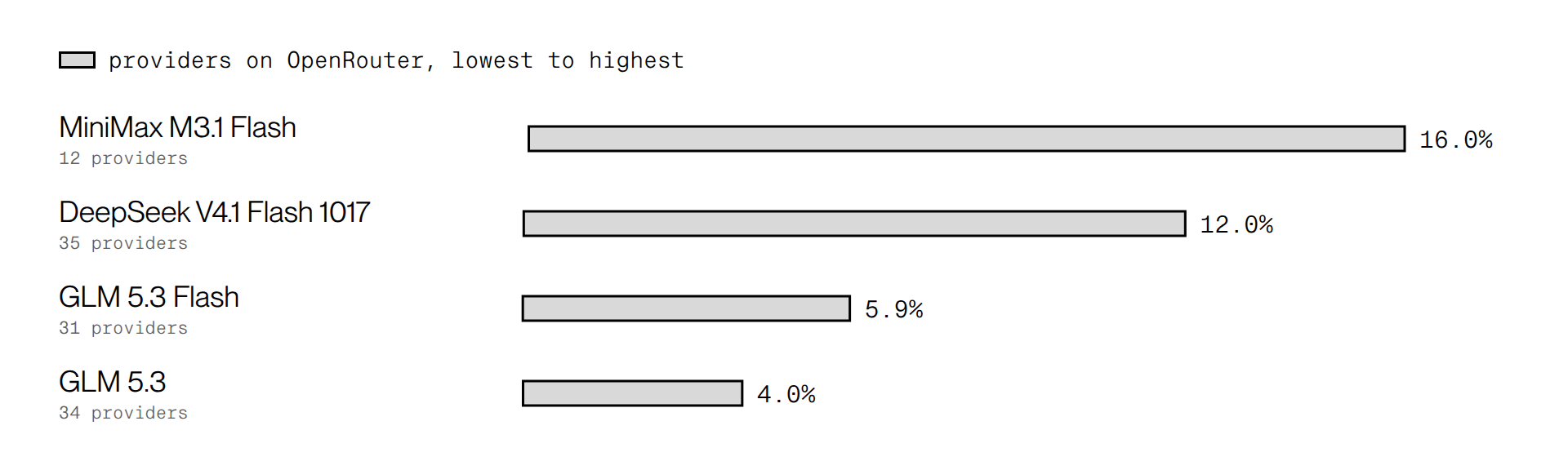
OpenRouter's published tool-call error rate per provider, 3 to 9 November 2026, for providers with at least 1,000 tool calls a day, from the .txt Tool-call index (providers.dottxt.ai).
Better where it steps in. Unchanged everywhere else.
We tested .lambda on Reflection's Beam 1.0, a 501B open-weight model, across the BFCL v3 benchmark.
On about a third of the attempts, .lambda had to step in and correct the model's output. Those attempts got better: the share of tasks solved went from 66.5% to 69.7%. On the other two thirds, the model had already written a valid call and .lambda left it alone. The score there was 75.2% with and without it.
No slowdown, even at 228 tokens a second.
Constrained generation has to decide which tokens are allowed before each one is generated. .lambda does that while the GPU is still busy with the forward pass, so the answer is ready before it's needed.
We timed .lambda and the library most engines use by default for this, on the same public benchmark data, with GLM 5.3 at batch 32. At the slowest provider's speed, the default library adds 3.4%. At the fastest, it adds 50.6%. .lambda adds nothing at any of them.
The default library’s cost also depends on the model. Per token, at p90, it takes 268 µs on GLM-5.3 and 160 µs on Kimi-K2.6, so every new model needs benchmarking again. .lambda takes 25 and 29 µs.
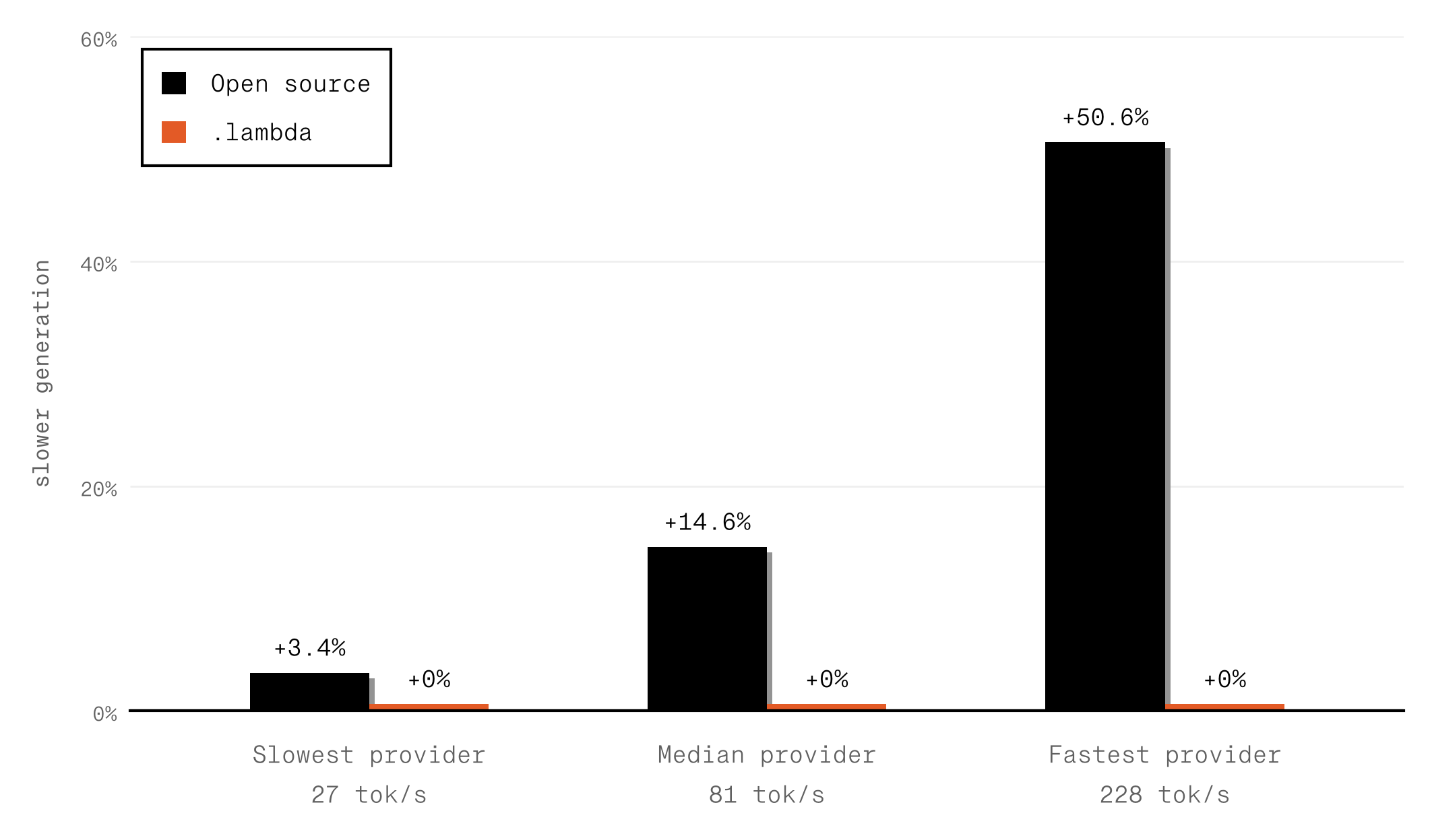
GLM 5.3, batch 32, public benchmark data. We timed each library on its own: how long it takes to work out the allowed tokens, with anything beyond the GPU's time per token counted as slowdown.
| Per token | Default library | .lambda |
|---|---|---|
| GLM-5.3, p50 | 41 µs | 15 µs |
| GLM-5.3, p90 | 268 µs | 25 µs |
| GLM-5.3, p99 | 430 µs | 45 µs |
| Kimi-K2.6, p50 | 42 µs | 16 µs |
| Kimi-K2.6, p90 | 160 µs | 29 µs |
| Kimi-K2.6, p99 | 235 µs | 51 µs |
Time per token to compute the next mask and accept the token, on the positions both libraries accepted: 787,107 on GLM-5.3 and 771,199 on Kimi-K2.6.
Supported on launch day, not a month later.
Developers judge a model, and the providers serving it, in its first week. A new open-weight model with tool calling ships about eight times a month, and engines can have tool-calling bugs open for months after launch.
We write the model's format definition before launch, from its documentation, chat template and raw generations, and qualify it on your engine before traffic.
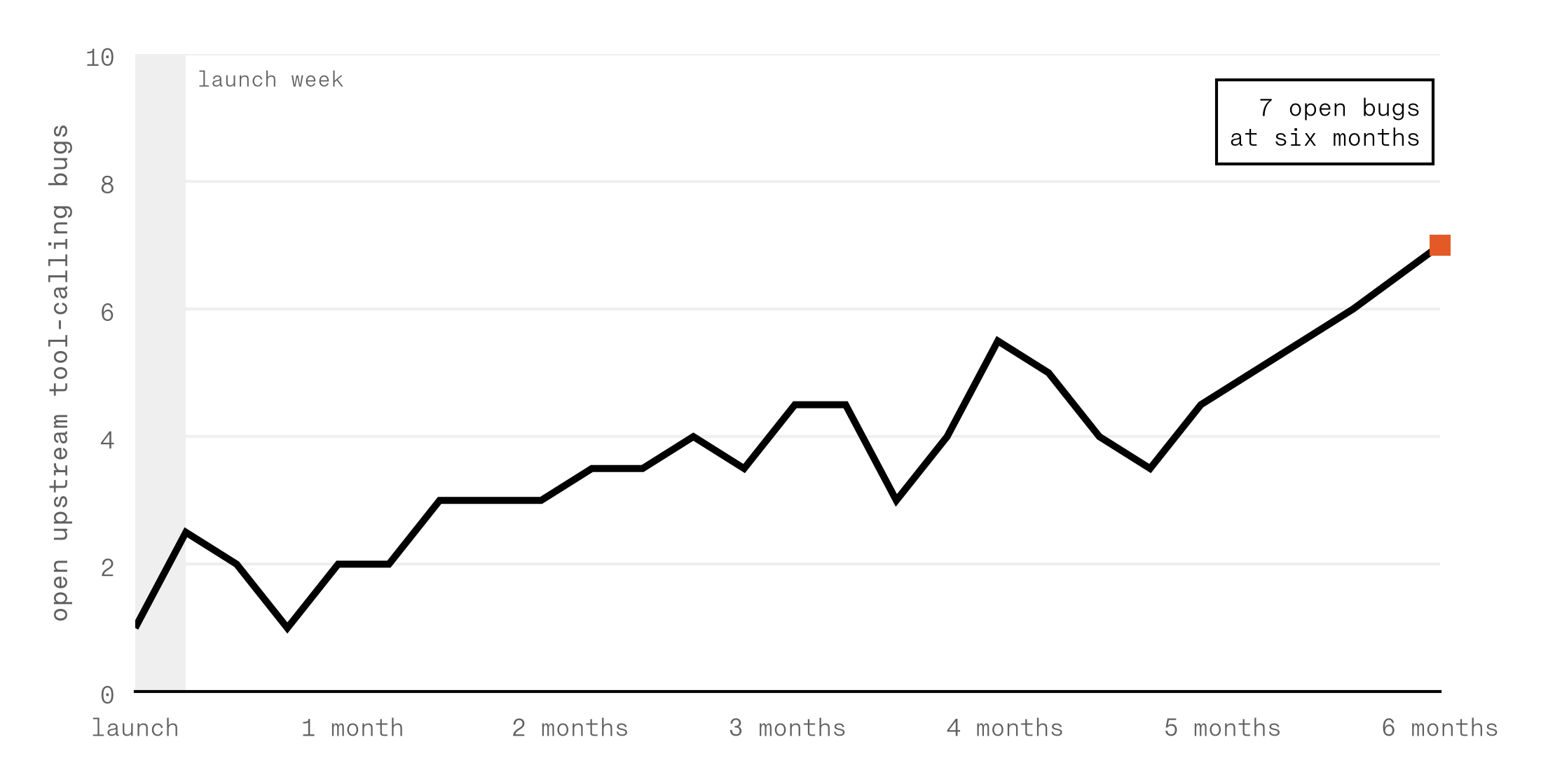
Median open tool-calling bugs in vLLM, SGLang and TensorRT-LLM for the 10 open-weight models with tool calling that had the most tool calls on OpenRouter from 3 to 9 November 2026, among those listed at least 180 days by 9 November.
It runs in your stack, and you stay in control.
.lambda runs inside your cluster, alongside vLLM, SGLang, TensorRT-LLM or ONNX Runtime GenAI. Customer requests never leave it, and we collect no telemetry.
.lambda takes the default library's place behind the same interface. We maintain the format definitions, fix the bugs and add new models as they ship.
Prove it on your worst endpoint.
Pick the model and engine where your tool calls fail most. With the scope agreed, an engineer assigned and the workload ready, the evaluation takes under a week.
Integrating the library has taken clients under two hours.
What the pilot includes
- 01You bring
An agreed scope and ready workload
One model and serving configuration, representative requests including known failures, required customer features and an assigned engineer.
- 02We run
The same requests on both engines
One engineer on each side integrates the library, reproduces the failures and compares correctness, task quality, performance under load and operational coverage.
- 03You receive
A decision-ready qualification report
How each engine did on your requests, what we don't support yet, and what a rollout would take.
What your engineering leads will ask.
Your current setup keeps working, and it stays as your fallback. The real question is who fixes it when a new model's format breaks the parser, and how fast. With open source, that's your team waiting on upstream. With .lambda, it's us.
No. Outlines is our open-source library, and it stays open source. .lambda is a commercial product built on a separate engine. It knows each model's tool-call format, parses calls as they stream, supports new models on launch day, and its time per token doesn't depend on the model. We maintain and support it in production.
Check how you're counting. Most monitoring catches bad JSON but misses the model answering in plain text when it should have called a tool. And a low rate today may not survive a new format or tokenizer.
Not necessarily. .lambda makes sure the call is well-formed. It doesn't make the model smarter. It also never rules out an answer the model could validly have given, so it doesn't make good answers worse: on BFCL with Beam 1.0, attempts where the model already wrote a valid call scored 75.2% with .lambda and 75.2% without. We measure task success separately so you can see both.
Not in our tests: timed on GLM 5.3 at 228 tokens a second, .lambda works out the allowed tokens before the GPU needs them. We timed the library on its own, so test it under your own batching during the pilot, because averages hide slow tails.
Usually just sample outputs from the model. We don't need the weights. Before release, we test it on your engine with your engineers.
A platform fee, tiered by traffic or by dedicated deployment. It includes bug and performance fixes, new model support and standard support.